Julia Parrey, Associate Member, Immigration and Human Rights Law Review
I. Introduction
“When they told us to reject the evidence in front of our eyes, we kept recording.”[1] Journalist Frank Bures shared his twist on the famous quote from George Orwell’s 1984 in describing the efforts of Minnesota residents and trained observers to document and expose the actions taken by Immigration and Customs Enforcement (“ICE”) agents during Operation Metro Surge in Minnesota.[2] These actions taken by officers resulted in the deaths of Renee Good and Alex Pretti, both of which became highly publicized largely because of video evidence captured by bystanders.[3] Bures explained how Minnesota’s resistance has been crucial to disprove falsehoods and inaccuracies; however, the right to record, as so many people have been brave enough to do, has been questioned and pushed back against by the very organizations it is needed to protect from.[4]
This Blog explores the First Amendment implications of recent actions by the United States Immigration and Customs Enforcement. Part II provides background on the broader foundational protections provided by the First Amendment of the United States Constitution, ICE’s background, and ICE’s recent actions which have potentially violated the Constitution and drawn widespread outrage and attention. Part III discusses potential legal resolutions of ICE’s actions and emphasizes citizen’s rights to record and document government agents. Finally, Part IV concludes by reviewing these issues and making a final reiteration of individuals’ First Amendment rights.
II. Background
The First Amendment to the United States Constitution is a foundational protection for free speech, free press, and the right to petition the Government; this most vital protection preserves and maintains citizens’ fundamental right to express themselves, to gather with others, and to speak out against the government when necessary.[5] However, these protections are under attack by organizations within the government itself.[6] In the wake of September 11th, the Homeland Security Act spurred government reorganization that led to the formation of a new body within the Department of Homeland Security (“DHS”): Immigration and Customs Enforcement (“ICE”).[7] To better understand the current tensions between the First Amendment and ICE’s action, an elaboration upon the relevant background is warranted. This section provides a brief overview of the First Amendment and the origins of ICE.
A. The First Amendment
The First Amendment provides that “Congress shall make no law…abridging the freedom of speech, or of the press….”[8] Historically, this protection was rooted in the Framers’ concern that unfettered speech and press were necessary to check governmental abuses and uphold the democratic process.[9] Thomas Jefferson claimed that “truth is great and will prevail if left to herself; she is the proper and sufficient antagonist to error, and has nothing to fear from the conflict unless by human interposition disarmed of her natural weapons, free argument and debate.” [10]
The protections of the First Amendment extend beyond traditional notions of political speech; it also protects individuals’ ability to gather and to disseminate information about the government and government conduct—including, but not limited to, documenting law enforcement activity.[11] Although the importance of the First Amendment draws its origins from the founding with the emphasis on freedom of expression after the American Revolution, it remains of critical importance; First Amendment protections have not just been continually protected, but they have expanded even further in the 20th and 21th centuries.[12] The Court has extended the First Amendment to cover more recent forms of communication, such as radio, film, television, video games, and the internet, reflecting the living and expanding nature of First Amendment protections in our current landscape.[13]
B. U.S. Immigration and Customs Enforcement
The United States Immigration and Customs Enforcement is the principal agency responsible for interior immigration enforcement and customs investigations, with more than 20,000 personnel members and a massive budget of $8 billion.[14] ICE’s activities include removal operations, detention, and criminal investigations related to immigration and customs violations.[15]
ICE was created under the Department of Homeland Security in 2003, making it a comparatively young federal agency.[16] Unlike local police, ICE operates at a federal level with broad, nationwide jurisdiction and a combination of civil and criminal authority to “better protect national security and public safety” in the wake of tragedy on 9/11.[17]
III. Discussion
This discussion examines growing tensions surrounding immigration enforcement and the response to those policies, particularly conflicts between federal authorities and individuals documenting enforcement activities. It then explains the constitutional basis for the First Amendment right to record government officials performing their duties in public spaces. Finally, it argues that these protections apply equally to immigration agents, emphasizing that documenting enforcement actions is a critical mechanism for accountability and democratic oversight.
A. Recent Tensions and Conflicts with ICE
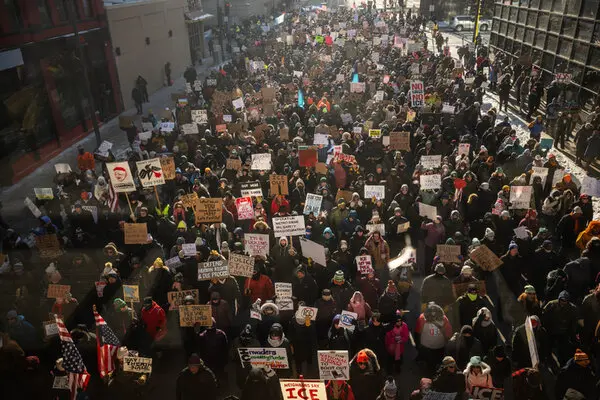
ICE has recently gained significant levels of attention and notoriety. Over the course of 2025 and the beginning of 2026, the Trump administration has sharply increased domestic immigration enforcement. The administration’s decision to pursue heightened enforcement has been driven by President Trump’s hateful and damaging rhetoric about immigrants; his political scare tactic of “secur[ing] the border” has been used to justify mass deportations and the dehumanization of immigrants.[18] “Operation Metro Surge” in Minneapolis was a massive federal deployment that resulted in multiple civilian fatalities and injuries, widespread protests, and national debate over federal enforcement tactics and protection of civil liberties.[19]
Alongside these events, DHS senior officials publicly characterized the act of recording ICE activity as potentially unlawful and even equivalent to “doxing” agents or obstruction.[20] A DHS bulletin released in June 2025 directed officers to consider the “use of cameras” and streaming or recording protests to constitute “unlawful civil unrest” tactics and ‘threats.’[21] Such statements signal a shift in DHS messaging about public documentation of enforcement actions that intersects with constitutional rights.
In practice, the implementation of DHS’s new policies has sparked reports of government agents directly targeting journalists, bystanders, and other individuals recording immigration enforcement activities. Specifically, agents have assaulted and aimed deadly weapons at individuals attempting to film DHS activity on public streets or identify officers.[22]
The current sociopolitical climate cannot be divorced from the dangerous shift in DHS and ICE activities. Polarized debates about immigration enforcement, federal authority, and civil liberties have placed ICE— once a relatively niche enforcement agency—at the center of public protest and legal challenge.[23] These tensions have in turn triggered deep concerns about free expression, accountability, and the rule of law.
B. The First Amendment Right to Document Government Officials
The First Amendment broadly protects speech, press, assembly, and petition.[24] These rights are even stronger in public forums, which traditionally include streets, sidewalks, and parks.[25] Numerous courts, from the Second Circuit, to the Ninth Circuit, to the District Court for the Central District of California, have repeatedly held that the right to photograph, film, or otherwise document government officials—including law enforcement officers performing official duties in public—constitutes protected expressive activity.[26] The ACLU has advised that photographing or filming things plainly visible in public spaces, including law enforcement and other government officials, is a protected constitutional right..”[27]
In National Rifle Association of America v. Vullo, the Supreme Court held that the First Amendment “prohibits government officials from wielding their power selectively to punish or suppress speech, directly or (as alleged here) through private intermediaries.”[28] Further, in Glik v. Cunniffe, the First Circuit held that a citizen’s arrest for filming state police officers in public violated his First and Fourth Amendment rights.[29] In that case, Simon Glik was arrested for recording three officers on the Boston Common arresting a young man; Glik was concerned that the officers were employing excessive force to conduct the arrest, and began filming from a ten foot distance.[30] Glik claimed that his subsequent arrest (under a Massachusetts wiretap statute) for this conduct violated his First Amendment rights.[31] The First Amendment protects the right to gather and disseminate information, including the right to film public officials performing their duties in public spaces.[32] Lower courts across other circuits have similarly upheld the right to record officers; even absent a Supreme Court ruling directly on point, circuits across the United States have recognized that recording police or federal agents in public is core First Amendment activity so long as it does not interfere with their duties.[33]
The rationale for this protection is simple: documenting government activity is a critical check on power.[34] According to the Reporters Committee for Freedom of the Press, “gathering information about government officials in a form that can readily be disseminated to others serves a cardinal First Amendment interest in protecting and promoting ‘the free discussion of governmental affairs.’[35] Whether captured by journalists, activists, or ordinary citizens, recordings can reveal misconduct, promote transparency, and facilitate informed democratic discourse. This is true for municipal police, federal agents, and, most importantly in the current sociopolitical, ICE agents.
C. ICE May Not Supersede First Amendment Protections
A person’s right to record, photograph, and document law enforcement conduct in public flows directly from the First Amendment.[36] First Amendment protections must be construed to include documentation of federal agents performing immigration enforcement in public spaces, where individuals may film from public sidewalks or other lawful vantage points provided they do not interfere with an agent’s duties.
Legally, recording agents is protected speech and press activity, regardless of whether the individual recording is a journalist, activist, or ordinary bystander. Indeed, senators have publicly demanded that DHS cease arrests of individuals simply for exercising this core constitutional right.[37] U.S. Senators Tammy Duckworth and Dick Durban, in a letter to DHS Secretary Kristi Noem, said that “failure to do so would be an admission that you are purposefully seeking to suppress free speech and impede government accountability through malicious, unlawful arrests intended to terrorize and silence American citizens who disagree with government actions.”[38]
DHS’s public claims that such recording is “violence” or doxing directly conflict with precedents recognizing that the First Amendment protects documentation of public officials.[39] Existing First Amendment protections cover the right to record agents, including ICE agents in the duties of their work.[40] Immigration and Customs Enforcement does not and should not receive special privileges contrary to the foundational protections provided by the First Amendment.[41] Instead, in the face of (often unjustified) violent actions being taken against citizens, the ability to record is necessary for the purposes of accountability and documentation. While ICE and government officials claim that recording constitutes ‘unlawful civil unrest,’ the conduct can reasonably be characterized as the opposite. In times of governmental overreach of power, communal action and public accountability are some of the only ways to protect each other and stand up for the most vulnerable communities; ICE’s actions are an attempt to undermine First Amendment protections, which have serious legal implications on the rights of individuals and the maintenance of a democratic system.[42]
IV. Conclusion
The First Amendment was designed to do one essential thing: keep power accountable.[43] It protects not only abstract speech and formal journalism, but also the everyday act of observing, documenting, and sharing what government officials do in public. That protection does not disappear when the officials involved are federal immigration agents; rather, it has become even more important. It does not depend on whether the person holding the camera is a reporter, an activist, or an ordinary citizen standing on a sidewalk. Recent actions and rhetoric from DHS officials stand in tension with decades of constitutional protection. Attempts to characterize recording as “violence,” “doxing,” or civil unrest blur critical constitutional lines and risk chilling lawful speech at a time when transparency is most needed.
Ultimately, ICE, like all government actors, operates within constitutional boundaries.[44] The First Amendment ensures that citizens retain the ability to watch, record, and speak about the exercise of public power.[45]
In moments of political intensity and public controversy, constitutional protections must matter more, not less. Immigration enforcement may be contentious and federal authority may be broad, but neither controversy nor authority overrides the First Amendment. The right to document government officials in public spaces is not a loophole or a privilege granted at the government’s discretion—it is a structural safeguard of democratic accountability.
[1] The Minnesota resistance exposed the Orwellian frauds of the administration, Minnesota Reformer (Mar. 11, 2026), https://minnesotareformer.com/2026/03/11/the-minnesota-resistance-exposed-the-orwellian-frauds-of-the-administration/ [https://perma.cc/Q64Q-VAKZ] [hereinafter The Minnesota resistance].
[2] Id.
[3] Id.
[4] Id.; Corin Hoggard & Paul Blume, ICE says it’s illegal to record agents, but is DHS policy actually unlawful?, Fox 9 (Jan. 13 2026), https://www.fox9.com/news/ice-says-recording-agents-illegal-federal-judge-says-dhs-policy-unlawful-jan-2026 [https://perma.cc/E567-HXTS].
[5] Five ways the First Amendment protects your speech – and three ways it does not, ACLU of D.C. (Aug. 15, 2024), https://www.acludc.org/news/five-ways-first-amendment-protects-your-speech-and-three-ways-it-does-not/ [https://perma.cc/D7YM-Y25K] [hereinafter Five Ways the First Amendment Protects Your Speech].
[6] The Minnesota resistance supra note 1.
[7] History, U.S. Immigr. & Customs Enf’t (Dec. 19, 2025), https://www.ice.gov/history [https://perma.cc/C7XN-KSYE].
[8] Five Ways the First Amendment Protects Your Speech, supra note 5.
[9] First Amendment, Nat’l Const. Ctr. (May 2, 2022), https://constitutioncenter.org/go/firstamendment [https://perma.cc/9S9S-YDX8].
[10] Id. (emphasis added).
[11] Id.
[12] Ronald Reagan Presidential Library & Museum, Constitutional Amendments – Amendment 1: “The Freedom of Speech,” Ronald Reagan Pres. Lib. & Museum, https://www.reaganlibrary.gov/education/lesson-plans/high-school/constitutional-amendments/constitutional-amendments-amendment-1 [https://perma.cc/HJ2Q-A79E] (last visited Mar. 16, 2026).
[13] Id.
[14] History, supra note 7.
[15] Id.
[16] Id.
[17] Id.
[18] Border and Immigration, The White House, https://www.whitehouse.gov/priorities/border-immigration/ [https://perma.cc/LS9M-TH9A] (last visited Mar. 16, 2026).
[19] Minnesota v. Noem: Operation Metro Surge fact sheet, Public Rts. Project (Jan. 22, 2026), https://www.publicrightsproject.org/minnesota-v-noem-operation-metro-surge-fact-sheet/ [https://perma.cc/7HR6-62E5].
[20] ICE says it’s illegal to record agents, but is DHS policy actually unlawful?, supra note 4.
[21] Freedom of Information Act Request, Am. Civ. Lib. Union (Nov. 18, 2025), https://assets.aclu.org/live/uploads/2025/12/2025.11.18-FOIA-Final.pdf [https://perma.cc/8CQA-MPPM].
[23] Id.
[24] Five Ways the First Amendment Protects Your Speech, supra note 5.
[25] Id.
[26] Filming and Photographing the Police, Am. Civ. Liberties Union, https://www.aclu.org/issues/free-speech/photographers-rights/filming-and-photographing-police [https://perma.cc/JTH3-YYCN] (last visited Mar. 16, 2026); Reyes v. City of New York, 141 F.4th 55 (2d Cir. 2025); Askins v. United States Dep’t of Homeland Sec., 899 F.3d 1035 (9th Cir. 2018); Hernandez v. County of San Bernardino, EDCV 20-1144 JGB (SPx), 2021 U.S. Dist. LEXIS 192537 (C.D. Cal. Aug. 13, 2021).
[27] Filming and Photographing the Police, supra note 26.
[28] NRA of Am. v. Vullo, 602 U.S. 175, 198 (2024).
[29] Glik v. Cunniffe, 655 F.3d 78 (1st Cir. 2011).
[30] Id. at 79.
[31] Id. at 79.
[32] Id. at 78.
[33] See Glik, 655 F.3d 78; see Reyes, 141 F.4th 55; Askins., 899 F.3d 1035; Hernandez, 2021 U.S. Dist. LEXIS 192537.
[34] Id.
[35] Filming Police in Public Is Protected by the First Amendment, Reporters Committee for Freedom of the Press (Aug. 29, 2011), https://www.rcfp.org/filming-police-public-protected-first-amendment/, [https://perma.cc/AA3J-4XJB].
[36] Id.
[37] Violet Miller, DHS Has Arrested People Filming Their Agents, and Sens. Duckworth, Durbin Say Those Arrests Must Stop, Tammy Duckworth (Oct. 30, 2025), https://www.duckworth.senate.gov/news/in-the-news/dhs-has-arrested-people-filming-their-agents-and-sens-duckworth-durbin-say-those-arrests-must-stop [https://perma.cc/45D3-Z7G8].
[38] Id.
[39] See Glik, 655 F.3d 78; see Reyes, 141 F.4th 55; Askins., 899 F.3d 1035; Hernandez, 2021 U.S. Dist. LEXIS 192537.
[40] See Glik, 655 F.3d 78; see Reyes, 141 F.4th 55; Askins., 899 F.3d 1035; Hernandez, 2021 U.S. Dist. LEXIS 192537.
[41] Freedom of Information Act Request, supra note 21.
[42] Id.
[43] First Amendment, supra note 9.
[44] Miller, supra note 37.
[45] See Glik, 655 F.3d 78; see Reyes, 141 F.4th 55; Askins., 899 F.3d 1035; Hernandez, 2021 U.S. Dist. LEXIS 192537.